Installation
Note
If you only want to use NeoN from Python, the quickest way is pip install neon_pde,
see Python bindings (neon_pde).
Requirements
Building NeoN from source requires
CMake >= 3.22
Ninja (required by the provided CMake presets)
gcc >= 13 or clang >= 19
Kokkos 5.0 - 5.2 (fetched automatically, see below)
Optional dependencies:
MPI, enabled by default; disable it with
-DNeoN_WITH_MPI=OFFif no MPI implementation is installedPETSc, SUNDIALS and ADIOS2, enabled via
NeoN_WITH_PETSC,NeoN_WITH_SUNDIALSandNeoN_WITH_ADIOS2
For GPU support:
NVIDIA: CUDA 12+
AMD: ROCm 6.4.1
Intel: oneAPI Base Toolkit 2024.2
C++ dependencies like Kokkos and Ginkgo are handled via CPM
and are cloned at the configuration step. However, the CMake build process prefers system-wide
installed C++ dependencies like Kokkos, cxxopts, etc. If you prefer to always clone, configure and
build the dependencies yourself, set -DCPM_USE_LOCAL_PACKAGES=OFF, see
CPM for more details.
On Ubuntu 24.04 the required tools can be installed via
sudo apt update
sudo apt install build-essential cmake ninja-build gcc-13 g++-13 python3 python3-dev
sudo apt install libopenmpi-dev  # optional, for MPI support
Building the documentation additionally requires Doxygen and the
Python packages listed in doc/requirements.txt:
sudo apt install doxygen
pip install -r doc/requirements.txt
For development it is required to use pre-commit.
Building from source
You can build NeoN by following these steps:
Clone the NeoN repository:
git clone https://github.com/exasim-project/NeoN.git
Navigate to the NeoN directory:
cd NeoN
NeoN uses CMake to build, thus the standard CMake procedure should work, however, we recommend using one of the provided CMake presets detailed below in Building with CMake Presets. From a build directory, you can execute:
mkdir build
cd build
cmake <DesiredBuildFlags> ..
cmake --build . -j<the number of CPU cores>
cmake --install .
By default, the command cmake –build . -j will use all the CPU cores available. It can consume a significant amount of memory when building with many cores. If you want to limit the number of cores used during the build step, you can specify the number of CPU cores as shown above.
The following can be chained with -D<DesiredBuildFlags>=<Value> to the CMake command. Most relevant build flags are:
Flag |
Description |
Default |
|---|---|---|
CMAKE_BUILD_TYPE |
Build in debug or release mode |
Debug |
NeoN_BUILD_DOC |
Build NeoN with documentation |
ON |
NeoN_BUILD_TESTS |
Build NeoN with tests |
OFF |
To browse the full list of build options it is recommended to use a build tool like ccmake.
By opening the the project with cmake-gui you can easily set these flags and configure the build.
NeoN specific build flags are prefixed by NeoN_.
Note
To install or build the Python bindings (the neon_pde package), including
the CUDA variant, see Python bindings (neon_pde).
Note
Releases are also published as conda packages to prefix.dev, which is the quickest way to get a prebuilt NeoN (C++ runtime, headers and CMake package files included) into a pixi environment:
pixi add neon-pde -c https://prefix.dev/exasim-project -c conda-forge
See Python bindings (neon_pde) for the available platforms and GPU flavours.
Building for GPUs
NeoN will automatically enable Kokkos_ENABLE_CUDA or Kokkos_ENABLE_HIP if either of this is available on
the system. This can be prevented by setting both options explicitly.
If NeoN does not detect the GPU backend automatically, you can set some relevant flags to enable GPU support during the configure step.
For NVIDIA GPUs, specifying the GPU architecture via CMAKE_CUDA_ARCHITECTURES should be sufficient.
-DCMAKE_CUDA_ARCHITECTURES=<GPU_ARCH>
For AMD GPUs, you may need to set up some relevant HIP environment variables before the configure step.
export PATH=/opt/rocm/bin:$PATH
export HIPCC_CXX=/usr/bin/g++  # If you want to use g++ as the host compiler
Then you can enable HIP during the configure step with the following flags.
-DCMAKE_CXX_COMPILER=hipcc
-DCMAKE_HIP_ARCHITECTURES=<GPU_ARCH>
-DKokkos_ARCH_AMD_<GPU_ARCH>=ON  # e.g., -DKokkos_ARCH_AMD_GFX90A=ON
In the case of Intel PVC GPUs, the following flags ensure sycl support.
-DCMAKE_CXX_COMPILER=icpx
-DCMAKE_CXX_FLAGS=-fsycl
-DCMAKE_BUILD_TYPE=release
-DKokkos_ENABLE_SYCL=ON
-DKokkos_ARCH_INTEL_PVC=ON
Please note that current support for NeoN on Intel GPUs is experimental.
After configuring for GPU support, you can continue to build NeoN.
Building with CMake Presets
Additionally, we provide several CMake presets to set commonly required flags if you compile NeoN in combination with Kokkos.
cmake --list-presets # To list existing presets
To build NeoN for production use, you can use the following commands:
cmake --preset production # To configure with ninja and common kokkos flags
cmake --build --preset production # To compile with ninja and common kokkos flags
It should be noted that the build directory changes depending on the chosen preset. This way you can have different build directories for different presets and easily switch between them.
Building with Spack
A good way to simplify the process of building NeoN is by using spack. Here is a short tutorial on how to build NeoN with spack for development. First clone spack from https://github.com/exasim-project/spack (until neon is fully merged into spack).
git clone https://github.com/exasim-project/spack -b neofoam
source spack/share/spack/setup-env.sh
Next we create a development environment for NeoN and add NeoN to it.
mkdir NeoN-env
spack env create  -d NeoN-env
spack env activate NeoN-env
cd NeoN-env
spack develop --path /home/greole/data/code/NeoN neon
Next we install clang 17 as a compiler into our environment
spack add llvm@17
spack install
spack compiler add "$(spack location -i llvm)"
Next, we add NeoN with the required dependencies.
spack add neon+test++cuda ^kokkos cuda_arch=80 cxxstd=20  ^ginkgo cuda_arch=80   %llvm@17
spack install
Executing Tests
Configure with -DNeoN_BUILD_TESTS=ON (enabled in the develop preset) and run the unit tests via
ctest --preset develop
Workflow with vscode
install the following extensions:
ms-vscode.cpptools
ms-vscode.cmake-tools
After installation, you can open the NeoN directory with vscode and configure the build with cmake presets with the cmake extension as shown below:
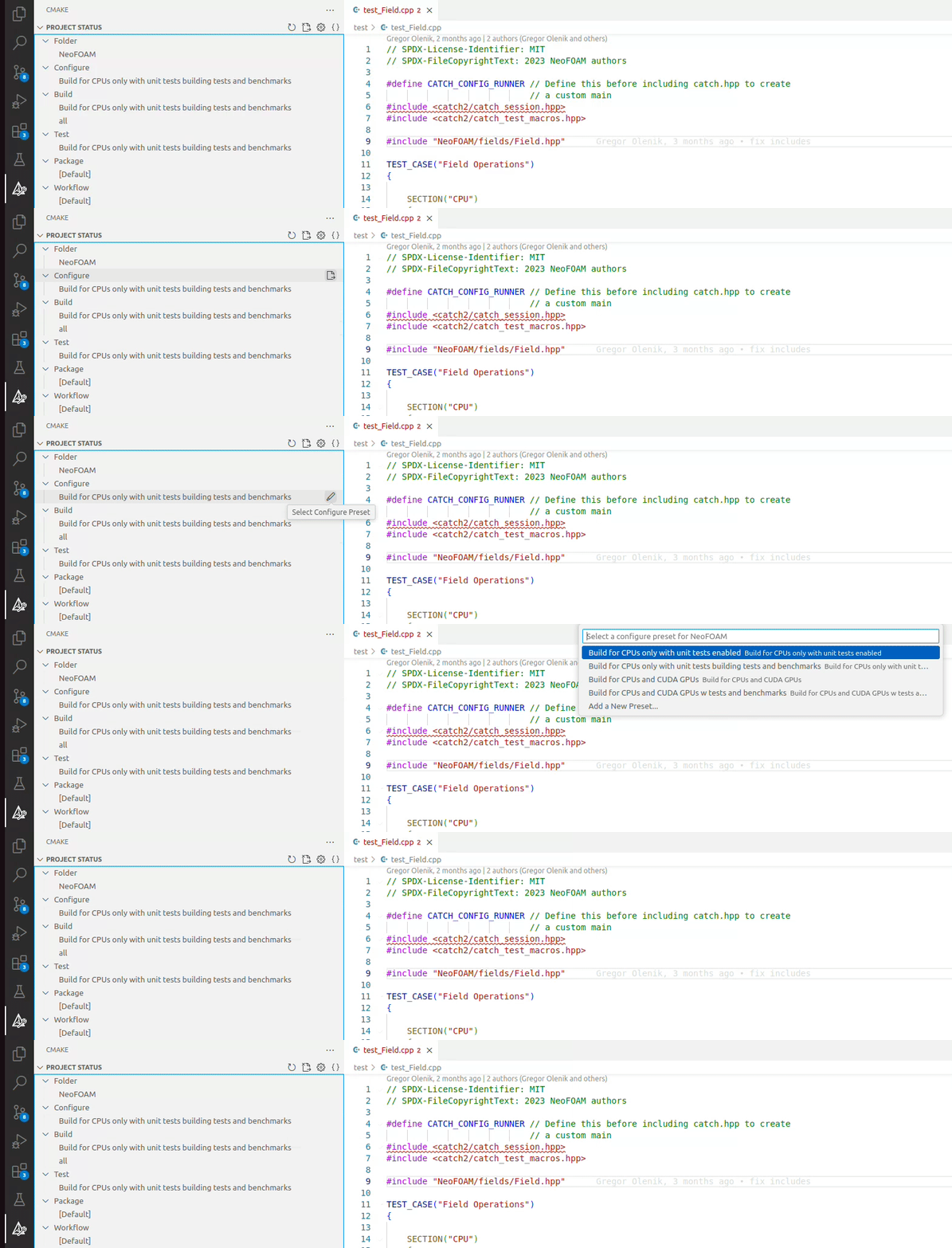
After configuring the build, you can build the project with the build button or test in “testing” tab (flask icon).
To create the documentation, you can use the ‘Build Sphinx Documentation’ task in the vscode task menu. Type Ctrl+P and type task and press space and the build documentation and press enter. The documentation will be created in the docs_build directory.