Note
Go to the end to download the full example code.
Build a scalar-transport solver from scratch
Build a complete NeoFOAM solver for unsteady scalar transport with a prescribed velocity field:
The smallest PDE that exercises every major framework piece — time
loop, field reads, dependency graph, fvm solve, topological
ordering — without pressure-velocity coupling.
Complete Add a passive scalar transport model first; this tutorial
reuses field(), depends_on, and parameter injection from
there.
Solver imports
import contextlib
import subprocess
from typing import Annotated, Any, Optional

import pybFoam as pyf
import pyvista as pv
from pybFoam import (
    Info,
    fvm,
    fvScalarMatrix,
    surfaceScalarField,
    volScalarField,
    volVectorField,
)

from neofoam import Depends, FieldUpdates, Solver, field

from neofoam.framework.context import Context
from neofoam.framework.graph import DAGResolver
from neofoam.framework.initialization import (
    ConfigContext,
    InitializerBuilder,
    InitStep,
    LoadResult,
    StagedInitRunner,
    StagedInitSpec,
    lazy,
)
from neofoam.framework.initialization.execution.ordering import (
    _topological_sort as topological_sort,
)
from neofoam.framework.operations import (
    IterativeOp,
    Operation,
    Operations,
    StepBuilder,
)
from neofoam.framework.types import OperationMetadata
from neofoam.tutorial import clone_case
Define the spec and the time-loop predicate
Solver("scalar_transport") returns an empty SolverSpec —
the analogue of Model from tutorial 2. TimeLoop is the
iteration condition for the outer loop; IterativeOp runs it
until it returns False.
class TimeLoop:
    def __call__(self, ctx: Context) -> bool:
        return bool(ctx.runtime.run())


scalar_transport = Solver("scalar_transport")
Build the staged initializer
create_init returns a StagedInitRunner. Its three stages are
registered as decorators on a per-call StagedInitSpec builder and
defined as closures so build can read runner.argv (the
framework sets runner.argv after create_init returns but
before runner.run()).
This solver has no plugin models, so LOAD and RESOLVE are trivial.
BUILD creates the runtime + mesh, then registers one field(...)
per object with depends_on listing prerequisite step names.
create_phi reads ctx["fields.U"] (the prefixed name) because
field("U", ...) produces an InitStep named fields.U.
def create_init(case_dir: Optional[Any] = None) -> StagedInitRunner:
    spec_builder = StagedInitSpec.build("scalar_transport")

    @spec_builder.load
    def load_config() -> LoadResult:
        return LoadResult(core_models=[], optional_models=[])

    @spec_builder.resolve
    def resolve_models(config: ConfigContext) -> None:
        pass

    @spec_builder.build
    def build_lazy(
        core_models: list[Any], optional_models: list[Any]
    ) -> list[InitStep]:
        argv = runner.argv
        builder = InitializerBuilder()
        builder.add(lazy("runtime", lambda _ctx: pyf.Time(pyf.argList(argv))))
        builder.add(
            lazy("mesh", lambda ctx: pyf.fvMesh(ctx["runtime"]), depends_on=["runtime"])
        )

        def create_T(ctx: dict[str, Any]) -> volScalarField:
            return volScalarField.read_field(ctx["mesh"], "T")

        def create_U(ctx: dict[str, Any]) -> volVectorField:
            return volVectorField.read_field(ctx["mesh"], "U")

        def create_D(ctx: dict[str, Any]) -> volScalarField:
            return volScalarField.read_field(ctx["mesh"], "D")

        def create_phi(ctx: dict[str, Any]) -> surfaceScalarField:
            return pyf.createPhi(ctx["fields.U"])

        builder.add(field("T", create_T, depends_on=["mesh"]))
        builder.add(field("U", create_U, depends_on=["mesh"]))
        builder.add(field("D", create_D, depends_on=["mesh"]))
        builder.add(field("phi", create_phi, depends_on=["fields.U"]))

        return builder.build()

    runner = StagedInitRunner(spec_builder.finalize())
    return runner
Register the initializer
Every solver has exactly one @initializer. The
Annotated[..., Depends(create_init)] marker tells the framework
to call create_init() and pass its return value as init_obj.
@scalar_transport.initializer
def initialize(
    self: Any,
    init_obj: Annotated[StagedInitRunner, Depends(create_init)],
) -> Context:
    return init_obj.run()
Define the execution graph
builder.loop(...) returns a fresh StepBuilder scoped to the
new loop’s body. We return an empty Operations() because no
plugin contributes operations to this solver.
@scalar_transport.execution_graph_step
def execution_graph(
    self: Any,
    domain_name: Optional[str] = None,
) -> tuple[StepBuilder, Operations]:
    ops = self.operations

    builder = StepBuilder()
    time_loop_op = Operation(
        func=IterativeOp(TimeLoop()),
        metadata=OperationMetadata(op_name="time_loop"),
    )
    with builder.loop(time_loop_op) as time_builder:
        time_builder.step(ops["increment_time"])
        time_builder.step(ops["solve_T"])
        time_builder.step(ops["write_output"])

    return builder, Operations()
Add the solver’s operations
Three operations: increment time, solve T, write output.
Parameter-name injection on solve_T pulls T, U, phi,
D from ctx.fields.
@scalar_transport.operation()
def increment_time(self: Any, ctx: Context) -> None:
    Info(f"Time = {ctx.runtime.timeName()}")
    ctx.runtime.increment()


@scalar_transport.operation(depends_on=["increment_time"])
def solve_T(
    self: Any,
    T: volScalarField,
    U: volVectorField,
    phi: surfaceScalarField,
    D: volScalarField,
) -> FieldUpdates:
    TEqn = fvScalarMatrix(fvm.ddt(T) + fvm.div(phi, T) - fvm.laplacian(D, T))
    TEqn.solve()
    return FieldUpdates({"T": T})


@scalar_transport.operation(depends_on=["solve_T"])
def write_output(self: Any, ctx: Context) -> None:
    ctx.runtime.write(True)
    ctx.runtime.printExecutionTime()
Read a graph error
Worth seeing the resolver fail once. If you accidentally make
U depend on phi while phi already depends on U,
the cycle detector refuses to run. The fix is to delete the
bogus edge: U is read from disk and depends only on mesh;
phi derives from U, not the other way around.
cyclic_steps = [
    field("U", lambda ctx: None, depends_on=["fields.phi"]),
    field("phi", lambda ctx: None, depends_on=["fields.U"]),
]
try:
    topological_sort(cyclic_steps)
except Exception as exc:
    print(f"caught: {type(exc).__name__}: {exc}")
caught: InitializationGraphError: Circular dependency: fields.U -> fields.phi
Run the new solver on the bundled case
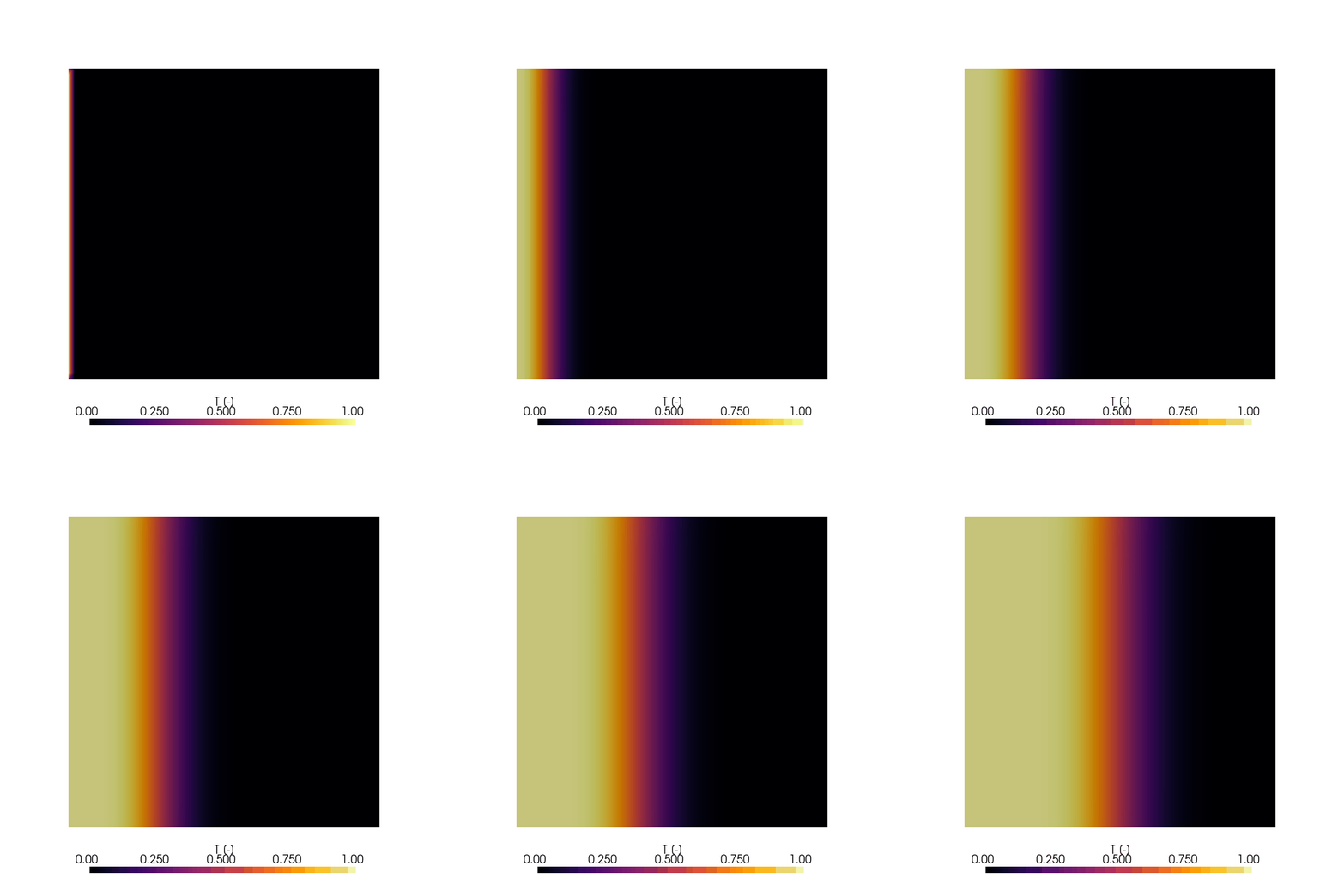
tutorials/scalar_transport_min is a 50×50 unit-square mesh with
uniform inflow U=(0.5, 0, 0) and a tracer-1 inlet driving
advection-diffusion of T.
case = clone_case("scalar_transport_min")
(case / "scalar_transport_min.foam").touch()
subprocess.run(["blockMesh", "-case", str(case)], check=True)

with contextlib.chdir(case):
    solver = scalar_transport.instantiate(argv=["scalar_transport"])
    ctx = solver.initialize()
    builder, model_ops = solver.execution_graph()
    resolver = DAGResolver()
    resolved = resolver.resolve(builder, model_ops)
    resolved.operations.run(ctx)
Animate the diffusion-advection front
Watch T sweep across the domain as advection pushes the
inlet’s T = 1 boundary condition downstream and diffusion
smears the front. A static frame would mean solve_T never ran.
reader = pv.OpenFOAMReader(str(case / "scalar_transport_min.foam"))

pl = pv.Plotter(off_screen=True, window_size=(700, 700))
pl.open_gif(str(case / "scalar_transport.gif"), fps=8)

reader.set_active_time_value(reader.time_values[0])
mesh = reader.read()["internalMesh"]
pl.add_mesh(
    mesh,
    scalars="T",
    cmap="inferno",
    clim=[0, 1],
    scalar_bar_args={
        "title": "T [-]",
        "vertical": False,
        "position_x": 0.2,
        "position_y": 0.05,
        "width": 0.6,
        "height": 0.04,
    },
)
pl.view_xy()

for t in reader.time_values:
    reader.set_active_time_value(t)
    mesh.copy_from(reader.read()["internalMesh"])
    pl.write_frame()

pl.show()
Total running time of the script: (0 minutes 1.328 seconds)